How to Start an Import and Export Business in India: A Step-by-Step Beginner's Guide
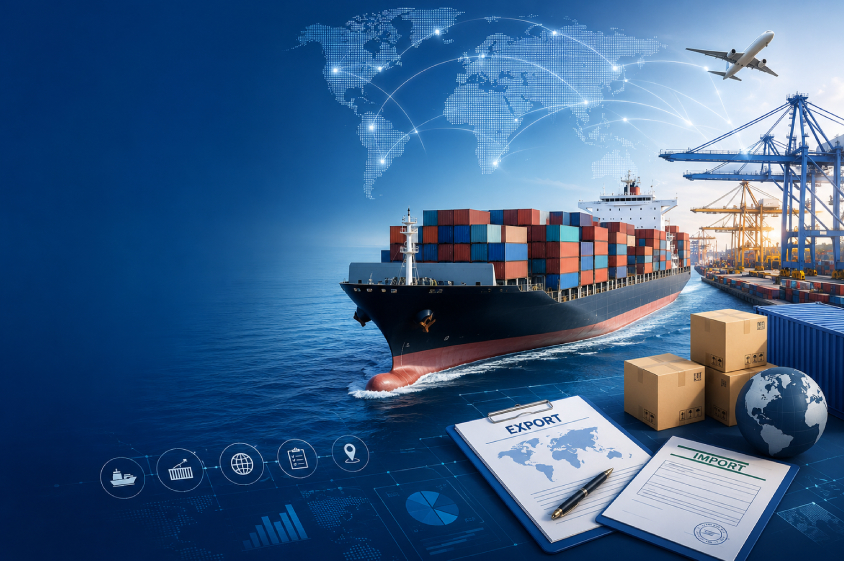
India is one of the world's fastest-growing economies, and its trade sector is at the heart of that growth. With exports crossing $776 billion in FY 2023-24 and imports adding another $854 billion, the import-export industry represents one of the most promising business opportunities available today.
Whether you are a college graduate, a working professional looking to switch careers, or an entrepreneur eager to go global, starting an import and export business in India is more accessible than most people think. What you need is the right knowledge, the right registrations, and a structured approach.
This comprehensive beginner's guide walks you through every step — from understanding the basics of international trade to registering your business, obtaining licenses, finding buyers, and managing shipments. By the end of this guide, you will have a clear roadmap to launch your own import-export business in India confidently.
WHAT IS THE IMPORT AND EXPORT BUSINESS?
The import and export business, also known as the EXIM business, involves buying goods and services from one country and selling them to another. Exporters sell Indian products to international markets, while importers bring foreign goods into India for domestic sale.
Traders in this business typically fall into three categories:
- Export Management Companies (EMCs): These companies act as representatives for Indian manufacturers who want to sell products overseas. They handle the entire export process on the manufacturer's behalf.
- Import/Export Merchants: These are independent traders who buy goods from manufacturers in one country, assume ownership of those goods, and then sell them to buyers in another country entirely on their own account.
- Export Trading Companies (ETCs): These companies bring together buyers and sellers from different countries. They identify what foreign markets need, source those products locally in India, and facilitate the trade.
India's major export sectors include engineering goods, petroleum products, gems and jewellery, chemicals, pharmaceuticals, textiles, agricultural produce, and electronic goods. On the import side, India primarily imports crude petroleum, electronic goods, gold and precious metals, heavy machinery, and chemical inputs.
WHY START AN IMPORT AND EXPORT BUSINESS IN INDIA?
India's position as a global trading hub makes it an exceptionally good base for EXIM business. Here are the core reasons why now is the right time to get started:
► Large and Diverse Manufacturing Base: India produces a vast range of goods at competitive prices. From handicrafts and spices to industrial machinery and pharmaceuticals, Indian exporters have access to products that are in global demand.
► Government Support and Incentives: The Indian government actively promotes exports through schemes such as the Merchandise Exports from India Scheme (MEIS), Remission of Duties and Taxes on Exported Products (RoDTEP), Export Credit Guarantee Corporation (ECGC) cover, and duty-free import authorisations under the Advance Authorisation Scheme. Understanding the Foreign Trade Policy of India is essential to take full advantage of these benefits.
► Growing Global Demand for Indian Products: Indian textiles, spices, organic products, IT services, and generic medicines are sought after worldwide. New Free Trade Agreements (FTAs) with the UAE, Australia, and other nations are opening up fresh markets.
► Low Entry Barriers: Unlike manufacturing, starting an EXIM business does not require a large factory or heavy capital investment. Many successful exporters start with a trading licence, a laptop, and strong supplier relationships.
► High Profit Potential: By buying in bulk at domestic prices and selling at international rates or by importing goods with high domestic demand at competitive import costs traders can earn significant margins.
STEP 1: RESEARCH AND CHOOSE YOUR PRODUCT AND MARKET
The foundation of any successful EXIM business is selecting the right product and identifying the right market for it.
How to Choose Your Export Product:
Start by studying India's top export commodities. Look for products where India has a competitive advantage — whether in terms of price, quality, or natural resource availability. Consider your own background: if you come from a textile town or know a cluster of artisans, starting with handicrafts or garments may be natural.
Key questions to ask when choosing a product:
- Is there steady international demand for this product?
- Does India produce this product at a competitive cost?
- Are there restrictions or special licences required to export this product?
- Is the product perishable, and does it require special handling?
For importers, the question is slightly different:
Which foreign goods are in high demand in India but are either unavailable locally or available at uncompetitive prices? Capital goods, high-end electronics, specialty chemicals, and luxury products often fall into this category.
How to Identify Your Target Market:
Use resources such as the DGFT (Directorate General of Foreign Trade) website, the Export Promotion Councils relevant to your sector, the Trade Map tool from ITC Geneva, and India's Ministry of Commerce reports to identify which countries are the largest buyers of your chosen product.
Research import regulations, tariffs, labelling requirements, and cultural preferences of your target country. For example, exporting food products to the European Union requires compliance with specific food safety standards.
STEP 2: SET UP YOUR BUSINESS STRUCTURE
Before you can trade internationally, you need a properly registered business entity in India. You can operate as a sole proprietorship, a partnership firm, a Limited Liability Partnership (LLP), or a Private Limited Company.
For small beginners, a sole proprietorship is the simplest and cheapest to set up. However, if you plan to scale, an LLP or a Private Limited Company offers better credibility with foreign buyers and Indian banks.
Documents typically needed to register your business:
- PAN Card of the proprietor / partners / directors
- Aadhaar Card
- Proof of business address (rental agreement or own premises document)
- Bank account in the business name
Once your business is registered, open a current account with a bank that has strong trade finance capabilities. Banks such as SBI, HDFC, ICICI, and Axis offer dedicated export-import banking services including Letters of Credit (LC), Bank Guarantees, and pre-shipment and post-shipment export finance.
STEP 3: OBTAIN YOUR IMPORTER EXPORTER CODE (IEC)
The Importer Exporter Code, widely known as the IEC code, is the single most important registration for any EXIM business in India. It is a 10-digit unique identification number issued by the Directorate General of Foreign Trade (DGFT) under the Ministry of Commerce and Industry.
No entity can legally import or export goods from India without a valid IEC code with the exception of goods imported or exported for personal use.
How to Apply for IEC Code:
- Step 1: Visit the DGFT portal at dgft.gov.in and register as a new user.
- Step 2: Navigate to the 'Services' section and select 'IEC Profile Management.
- Step 3: Fill in the ANF 2A form with your business details including PAN, business address, and bank account details.
- Step 4: Upload scanned copies of your PAN card, address proof, bank certificate or cancelled cheque, and passport-size photograph.
- Step 5: Pay the government fee of Rs. 500 online.
- Step 6: Your IEC code is typically issued within 2 to 3 working days.
The IEC code is a lifetime registration with no renewal requirement. It must be quoted on all shipping bills, bills of entry, and customs documents.
STEP 4: REGISTER WITH EXPORT PROMOTION COUNCILS (EPC)
Export Promotion Councils are government-sponsored bodies that promote Indian exports in specific product categories. Registering with the relevant EPC gives you access to market intelligence, buyer-seller meets, trade fair participation subsidies, and product-specific export benefits.
Some major Export Promotion Councils in India:
- APEDA (Agricultural and Processed Food Products Export Development Authority) — for agro products
- GJEPC (Gems and Jewellery Export Promotion Council)
- FIEO (Federation of Indian Export Organisations) — general trade body
- CLE (Council for Leather Exports)
- EEPC India (Engineering Export Promotion Council)
- Pharmexcil (Pharmaceuticals Export Promotion Council)
- TEXPROCIL (Cotton Textiles Export Promotion Council)
Membership in the relevant EPC also gives you a Registration cum Membership Certificate (RCMC), which is required to avail of various export incentive schemes under the Foreign Trade Policy of India.
STEP 5: UNDERSTAND CUSTOMS, DUTIES, AND DOCUMENTATION
Customs clearance is one of the most critical and technical aspects of the EXIM business. Every shipment entering or leaving India must clear customs, which involves classifying the goods under the Harmonised System of Nomenclature (HSN), paying applicable duties and taxes, and submitting the correct documents.
Key Export Documents:
- Commercial Invoice: The primary financial document that details the buyer, seller, goods description, quantity, unit price, total value, currency, payment terms, and INCOTERMS.
- Packing List: A detailed breakdown of how the goods are packed, including the number of packages, dimensions, gross weight, and net weight of each package.
- Bill of Lading (Sea) / Airway Bill (Air): The contract of carriage issued by the shipping line or airline. It serves as proof of shipment and is required for the buyer to claim the goods at the destination port.
- Certificate of Origin: A document certifying that the goods were produced in India. It is issued by chambers of commerce such as the IMC Chamber of Commerce and Industry or by FIEO. Required by many importing countries for preferential tariff treatment.
- Shipping Bill: The customs export declaration filed at the Indian port of export, without which the goods cannot be cleared for export.
- Let Export Order (LEO): Issued by Indian Customs after examination and verification of the export shipment, giving permission for the goods to be loaded onto the vessel.
- GST Invoice and LUT (Letter of Undertaking): Exporters supplying goods under zero-rated GST must file a LUT to export without paying integrated GST, or alternatively pay IGST and claim a refund.
Understanding all of these documents thoroughly as well as the correct use of INCOTERMS 2020, which define responsibilities and risk transfer between buyers and sellers is non-negotiable for any serious exporter or importer. Enrolling in a structured Export Import Management Course will give you practical, hands-on training in each of these areas.
STEP 6: UNDERSTAND GST FOR IMPORT-EXPORT BUSINESS
Goods and Services Tax (GST) has a specific framework for international trade. Getting your GST compliance right is critical to avoid penalties and to claim refunds efficiently.
Key GST provisions for exporters and importers:
- Zero-Rated Exports: All exports of goods and services from India are treated as zero-rated supplies under GST. This means no GST is levied on exported goods. Exporters can either export under a Letter of Undertaking (LUT) and claim a refund of input tax credit, or pay Integrated GST (IGST) on exports and claim a refund.
- IGST on Imports: When goods are imported into India, IGST is levied in addition to Basic Customs Duty (BCD) and other applicable cess. Importers can claim input tax credit on the IGST paid, provided the imports are for business use.
- GST Registration: Any business whose annual turnover exceeds Rs. 40 lakh (Rs. 20 lakh for service providers) must register for GST. However, even if you are below the threshold, registering voluntarily is advisable for EXIM businesses since it enables you to claim ITC.
- Refund of GST on Exports: The GST refund process for exporters involves filing RFD-01 online, backed by the shipping bill and GSTR-1 data. Delays in refunds can severely impact cash flow, so understanding the process thoroughly is important.
For a thorough understanding of GST as it applies to export-import businesses, consider joining NIFT's GST Course for Exporters, which covers all GST rules, procedures, and documentation specifically relevant to international trade.
STEP 7: ARRANGE LOGISTICS AND FREIGHT FORWARDING
Once your goods are ready and all documentation is in place, you need to arrange the physical movement of goods from your location to the buyer's destination. This involves:
Choosing the Mode of Transport:
- Sea Freight: The most cost-effective option for large, heavy, or non-time-sensitive shipments. India has major ports at Mumbai (JNPT), Chennai, Kolkata, Nhava Sheva, Mundra, and Pipavav.
- Air Freight: Faster but significantly more expensive. Suitable for high-value, time-sensitive goods such as pharmaceuticals, electronics, perishables, or express courier shipments.
- Multimodal Transport: A combination of road, rail, sea, and air transport used for complex supply chains. Increasingly used for land-border trade with neighbouring countries.
Working with a Freight Forwarder:
A freight forwarder is a professional intermediary who arranges the entire logistics chain on behalf of exporters and importers. They book cargo space with carriers, coordinate inland transport, arrange customs clearance at origin and destination, and manage export documentation.
Choosing the right freight forwarder can save you significant time and cost. Look for forwarders who are members of FIATA (International Federation of Freight Forwarders Associations) and have experience with your specific trade lane and product type.
Learning about Customs Clearance and Freight Forwarding is a critical skill for any EXIM professional, whether you want to manage logistics in-house or simply communicate effectively with your freight partner.
STEP 8: DECIDE ON PAYMENT TERMS AND MANAGE FOREX
International payments differ significantly from domestic transactions. Understanding payment terms, trade finance instruments, and foreign exchange (forex) management is essential for protecting your business from financial risk.
Common Payment Methods in International Trade:
- Advance Payment (T/T – Telegraphic Transfer): The buyer pays before shipment. Most secure for the exporter, but difficult to negotiate with new buyers.
- Letter of Credit (LC): A bank guarantee issued by the buyer's bank assuring the seller of payment, provided the seller submits all required documents correctly. The most balanced and widely-used instrument for large trades.
- Documents Against Payment (DP): The seller ships the goods and sends documents to the buyer's bank, which releases documents to the buyer only upon full payment.
- Documents Against Acceptance (DA): The buyer accepts a bill of exchange and gets the documents, agreeing to pay by a future date. Riskier for the exporter as credit is extended.
- Open Account: The buyer pays after receiving goods, based on an invoice. Common only in long-term trusted relationships.
Managing Foreign Exchange Risk:
Because payment in international trade is often in foreign currencies (USD, EUR, GBP, etc.), exchange rate fluctuations can erode your profits. Use forward contracts with your bank to lock in exchange rates, or monitor the RBI's guidelines on hedging forex exposure.
Exporters also need to comply with FEMA (Foreign Exchange Management Act) regulations, which govern the repatriation of export proceeds within 9 months of shipment (or as extended by RBI).
STEP 9: MARKET YOUR BUSINESS AND FIND BUYERS OR SUPPLIERS
Finding buyers overseas (for exporters) or reliable suppliers abroad (for importers) is often the most challenging part of starting an EXIM business. Here are the most effective channels:
B2B Trade Platforms:
- Alibaba.com and Global Sources (widely used in Asia)
- IndiaMART (for finding domestic manufacturers to export)
- TradeIndia and ExportersIndia
- Europages (for European buyers)
- Kompass (global B2B directory)
Trade Fairs and Exhibitions:
Participating in international trade fairs gives you direct access to global buyers. INDIA EXPO MART (Greater Noida), India International Trade Fair (New Delhi), and India International Jewellery Show (Mumbai) are prominent platforms. Overseas, fairs like Canton Fair (China), Ambiente (Frankfurt), and Automechanika (Frankfurt) are important for respective sectors.
Export Promotion Council Events:
EPCs regularly organise Buyer-Seller Meets (BSMs) both within India and in target markets abroad. These provide warm introduction opportunities with verified international buyers.
LinkedIn and Digital Marketing:
Build a professional LinkedIn company page and connect with procurement managers and import agents in your target markets. A well-optimised website with product catalogues, certifications, and export credentials greatly increases your credibility with foreign buyers.
Embassies and Trade Commissions:
Indian embassies abroad and foreign embassies in India often maintain trade directories and can facilitate introductions. The Commercial Wing of Indian embassies actively supports Indian exporters in finding buyers.
STEP 10: UNDERSTAND INCOTERMS 2020
INCOTERMS (International Commercial Terms) are standardised trade terms published by the International Chamber of Commerce (ICC) that define the responsibilities, risks, and costs shared between buyers and sellers in international transactions.
INCOTERMS 2020 consists of 11 terms:
For Any Mode of Transport:
- EXW (Ex Works): Seller's obligation ends at their premises. Buyer bears all costs and risks.
- FCA (Free Carrier): Seller delivers goods to a named carrier at a named place.
- CPT (Carriage Paid To): Seller pays freight to the named destination but risk transfers when goods are handed to the carrier.
- CIP (Carriage and Insurance Paid To): Like CPT but seller also provides insurance.
- DAP (Delivered at Place): Seller delivers to the named destination, uncleared for import.
- DPU (Delivered at Place Unloaded): Seller delivers goods unloaded at the named destination.
- DDP (Delivered Duty Paid): Seller bears all costs including import duties at the buyer's destination. Most obligations on the seller.
For Sea and Inland Waterway Transport:
- FAS (Free Alongside Ship): Seller delivers goods alongside the vessel at the port of shipment.
- FOB (Free on Board): Risk transfers when goods are on board the vessel. One of the most commonly used terms in India.
- CFR (Cost and Freight): Seller pays freight to destination; risk transfers at the vessel.
- CIF (Cost, Insurance and Freight): Like CFR but seller provides marine insurance. Very common for imports into India.
Mastering INCOTERMS 2020 is fundamental for correctly pricing your quotations, allocating risk, and drafting air-tight contracts with international counterparts.
STEP 11: COMPLY WITH IMPORT-EXPORT REGULATIONS AND SPECIAL LICENCES
Not all products can be freely imported or exported. The DGFT classifies goods under three categories:
- Free: Goods that can be exported or imported without any restrictions. The majority of goods fall under this category.
- Restricted: Goods that require a specific licence from DGFT or another designated authority before they can be traded. Examples include certain agricultural products, chemicals, and waste materials.
- Prohibited: Goods that cannot be exported or imported at all. This includes wild animals, certain antiques, and specific hazardous materials.
Additionally, some products require compliance with standards set by specialised agencies:
- Food and agricultural products: FSSAI (Food Safety and Standards Authority of India) and APEDA
- Pharmaceuticals: CDSCO (Central Drugs Standard Control Organisation)
- Electronic goods: BIS (Bureau of Indian Standards)
- Textiles: Textile Committee
Before finalising your product selection, always verify its classification under the ITC-HS code and check whether it appears on any restricted or prohibited list. A single oversight here can lead to shipment detention, financial penalties, or worse.
STEP 12: CONSIDER EXPORT FINANCE AND INSURANCE
Cash flow management is a significant challenge in export business because there is often a considerable gap between the time you manufacture or purchase goods and the time you receive payment. Several financial products are designed specifically to help exporters bridge this gap.
Pre-Shipment Finance: Also called packing credit, this is a working capital loan extended by banks to exporters to finance the purchase of raw materials, processing, packaging, and transportation of goods before shipment.
Post-Shipment Finance: Finance extended after the goods have been shipped, against the export documents submitted to the bank, till payment is received from the overseas buyer.
Export Credit Guarantee Corporation (ECGC): ECGC is a government body that offers export credit insurance to protect Indian exporters against non-payment risk from foreign buyers and political risks in buyer countries. Buying ECGC cover is strongly advisable, especially when dealing with new buyers or politically volatile markets.
Working with Banks for EXIM Finance: Build a relationship with your bank's trade finance team early. They can guide you on LC discounting, negotiation of export bills, bank guarantees for advance payments, and buyer's credit for imports.
COMMON MISTAKES BEGINNERS MAKE IN IMPORT-EXPORT BUSINESS
Avoid these pitfalls that trip up many first-time EXIM entrepreneurs:
- Skipping Market Research: Jumping into a product or market without verifying actual demand, competition, or import regulations in the target country leads to unsold stock and financial loss.
- Ignoring Documentation: A single missing or incorrect document can cause your shipment to be held up at customs for weeks, leading to demurrage charges, spoilage, and buyer dissatisfaction.
- Not Understanding INCOTERMS: Confusion over who bears freight and insurance costs can cause disputes and erode profit margins drastically.
- Underpricing Exports: Many beginners price exports based on domestic costs alone, forgetting to account for packaging, freight, insurance, customs duties at destination, agent commissions, and foreign exchange conversion costs.
- Working Without a Written Contract: Always have a formal sales contract or purchase order that specifies product description, quantity, price, payment terms, delivery timeline, INCOTERMS, and dispute resolution mechanism.
- Ignoring Forex Risk: Leaving foreign exchange exposure unhedged can turn a profitable deal into a loss-making one when the currency moves against you.
- Not Seeking Professional Training: EXIM involves specialised knowledge in trade law, shipping logistics, customs procedures, and international finance. Trying to learn everything on the job without structured training leads to costly mistakes.
Why Choose NIFT?
- Industry experts as visiting faculty with rich, hands-on experience
- Updated study material specifically designed for the EXIM industry
- Industrial visits during the course to gain real-world exposure
- 100% placement assistance for career-seeking students
- Batches at multiple convenient Mumbai locations: Dadar, Andheri, Churchgate, and Thane
- Both online and offline learning options available
- Strong alumni network across leading companies including Maersk, Mediterranean Shipping Co., Reliance Industries, Tata, Mahindra, Cipla, Dr. Reddy's, and more
Whether you want to launch your own import-export business in India or build a career in the global trade industry, NIFT's programmes give you the structured foundation, practical skills, and professional network to succeed.
❓Top 7 FAQs
- Can I start an import-export business in India with a small capital?
Yes. You do not need a large investment to start. Many exporters begin as trading intermediaries, connecting domestic manufacturers with overseas buyers without holding inventory. The primary investment is in registrations (IEC, GST), a website, trade fair participation, and professional training. - What is the minimum capital required to start an export-import business in India?
There is no government-mandated minimum capital. Many successful exporters have started with Rs. 50,000 to Rs. 2 lakh covering registrations, a basic office setup, website development, and initial marketing. Working capital for actual trade transactions can be arranged through bank packing credit once you have an export order. - Is the IEC code mandatory for all exporters and importers?
Yes. No person or entity can export or import goods into/from India without a valid IEC code, except for personal use goods and certain government imports. The IEC is issued by DGFT and is a one-time, lifetime registration. - Do I need to know foreign languages to run an export-import business?
Not necessarily. English is the dominant language in international trade and is sufficient for communication with buyers and suppliers in most markets. However, knowing the local language of your primary target market is always an advantage. - What type of goods is best to export from India?
India has a competitive advantage in textiles and garments, handicrafts, leather goods, spices and food products, generic pharmaceuticals, engineering goods, gems and jewellery, chemicals, and organic products. The best product for you depends on your existing network, location, and available supplier relationships. - How long does it take to set up an import-export business in India?
Getting your basic registrations (business registration, IEC, GST) in place takes approximately 2 to 4 weeks. Finding your first buyer or supplier and executing the first shipment may take 3 to 6 months depending on your product, target market, and marketing effort. - How can NIFT help me start my import-export business?
NIFT's Diploma in Export-Import Management provides end-to-end training covering all the steps outlined in this guide from product selection and market research to documentation, customs, logistics, forex management, and export finance. NIFT also offers specialised intensive batches for those who want to start a business quickly and can travel to Mumbai for a short-duration full-time programme.
Final Thoughts: Build a Future-Ready Career in Import and Export Business in India
Starting an import-export business in India is one of the most rewarding entrepreneurial journeys you can undertake. India's manufacturing strength, government export incentives, and growing global footprint create an environment where well-prepared traders can build genuinely profitable, scalable businesses.
The key ingredients for success are: choosing the right product and market, completing all required registrations, mastering documentation and customs procedures, building strong logistics and banking relationships, and most importantly investing in professional knowledge before you begin.
International trade is not a business you can afford to learn purely through trial and error. Structured professional training from an institution like NIFT dramatically shortens your learning curve, helps you avoid expensive mistakes, and connects you with an industry network that opens doors.
If you are serious about starting or advancing in the import-export industry, explore NIFT's courses and take the first step toward a career or business with truly global reach.
Ready to begin? Contact NIFT today at +91 7400112277 or write to niftcourses@gmail.com to learn which programme is right for you.